Creating Variations

Self-pollination can be done to produce a range of varying offspring. Usually, the offspring plant with the most desirable phenotypical characterisitics are...

Creating Variations

Singapore Garden Festival 2010

The Singapore Garden Festival is fast approaching on the 15th of July. Setups have already begun for a few days now with heavy hardscapes making the...

Singapore Garden Festival 2010

Dendrobium Lips

These photos were taken by avid photographer, Ms Rita Sim, during her visit to our nursery a few months ago. You may view the full collections of her works here....

Dendrobium Lips

Dendrobium Singapore Scouts

In commemorating the centennial celebrations in the year 2010, the Singapore Scout Association has adopted a unique Orchid hybrid, and named it the...

Dendrobium Singapore Scouts

Tropical Snowmen

As part of Singapore Botanical Garden’s 150th Anniversary and year end celebrations, we were cordially invited to be part of the companies/organizations that...

Tropical Snowmen

Creating Variations

Self-pollination can be done to produce a range of varying offspring. Usually, the offspring plant with the most desirable phenotypical characterisitics are selected for cloning (A.K.A. mass production). In reality, a batch of clones are not guaranteed to yield identical flowers. A slight degree of variance can still surface; and mutations (due to chemical/environment etc) amongst some of the plants are still possible.

To illustrate, the following are examples of the Dendrobium Shavin White and two variations:

The typical Dendrobium Shavin White flower is greenish-white when it blooms initially. The greenish colouration fades resulting in a more whitish colour, as the flower fully blossoms.

In variation 1, pink flushes are observed along the petals and sepals, with a strong pigmentation of pink along the centre of the lip.

In variation 2, the reddish-pink colouration can be observed spreading from within the column.

Cloning the above variations could produce batches of atypical looking Dendrobium Shavin Whites. However, if the variations arose from unstable mutations, there’s a higher chance that their clones may end up being typical rather than atypical based on our experience.
The Dendrobium Shavin White cut-flowers have been circulating in the market for almost three decades. The Dendrobium Shavin White’s sustainability over the years is attributed to its well-aligned blooms, lasting flowers and strong flower stalks; and also being frequent flowering and maturing quickly. Notwithstanding, favourable genes from its pedigree should be credited. The Dendrobium Shavin White is a cross between the Dendrobium Walter Oumae and Dendrobium Queen Florist. In particular, the Dendrobium Walter Oumae has favourable characteristics and is used extensively for crossing. (It is the parent of more than 50 registered orchid hybrids).

Notably, both parents of the Dendrobium Shavin White are prominently white in colour, so it’s peculiar to find pinkish or reddish colourations. Bearing that in mind, reddish colours could already be embedded within its recessive genes; and only by chance will they be revealed. The following picture and magnification shows the typical (greenish-white) Dendrobium Shavin White, but a slight tinge of pink can be observed along the pedicel (“branch” attaching the flower to the stem). Due to its ancestry or hidden recessive genes, the Dendrobium Shavin White have the mutative propensity to reveal the reddish colour. Through self-pollination, typically hidden characteristics are uncovered and amplified.

ShavinWhite Magnified

Share and Enjoy:
  • Digg
  • Twitter
  • del.icio.us
  • Facebook
  • StumbleUpon
  • Google Bookmarks
  • Technorati
  • LinkedIn

Singapore Garden Festival 2010

The Singapore Garden Festival is fast approaching on the 15th of July. Setups have already begun for a few days now with heavy hardscapes making the initial entry whilst the softscapes coming in batches. Vendors and designers are also promptly preparing.

Here’s a glimpse of the entrance of the 4th floor’s orchid show still at work :

The Oncidium Walkway

The Oncidium Walkway

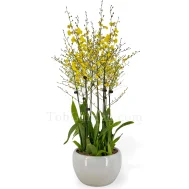
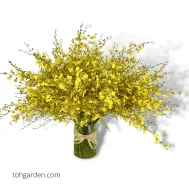
Be dazzled by these Oncidium trees along the aisle leading to the main site of the orchid show. The trees look like a mass of gold from afar and when passing beneath them, there’s some resemblance to cherry blossom trees during their seasons but with yellow blossoms instead of pink ones.

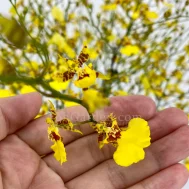
(The Oncidium Golden Shower/Golden Wish, also known as the “Dancing Ladies” in layman term, is one of the major cut orchid exported by Singapore. This hybrid is also commonly used for orchidscapes and displays that augment its characteristicly elegant arching manner of its flowers, in an outward manner, as its flowers matures.)

Another spectacular view that was close to completion yesterday was the stalagmite and stalactite orchidscape fixated and blended into the main entrance just outside the site of orchid show. The ceiling of the entrance and a few other trees that are also covered with a range of different coloured hybrids from the Oncidium Alliance.

Orchids secured to the ceiling

Orchids secured to the ceiling

Stalagmite & Stalactite

Stalagmite & Stalactite

Those who are keen on attending the Garden & Orchid Show, you may grab your tickets at
http://www.singaporegardenfestival.com/ or at the front desk of the showroom at Suntec City Convention Hall. The Garden Show will be on from the 15th to the 22nd of July.

For vendors, traders, growers and societies who are exhibiting/visiting Singapore during this period of time may contact us for a visit to our nursery to learn more about tropical orchids that we grow in Singapore’s nurseries. We will be available to bring visiting groups from the 18th of July on.

More pictures updated below just before the start of the show:

Share and Enjoy:
  • Digg
  • Twitter
  • del.icio.us
  • Facebook
  • StumbleUpon
  • Google Bookmarks
  • Technorati
  • LinkedIn

Dendrobium Lips

These photos were taken by avid photographer, Ms Rita Sim, during her visit to our nursery a few months ago. You may view the full collections of her works here.

*This entry was backdated.
** Photos courtesy of Ms Rita Sim

Share and Enjoy:
  • Digg
  • Twitter
  • del.icio.us
  • Facebook
  • StumbleUpon
  • Google Bookmarks
  • Technorati
  • LinkedIn

Dendrobium Singapore Scouts

In commemorating the centennial celebrations in the year 2010, the Singapore Scout Association has adopted a unique Orchid hybrid, and named it the Dendrobium Singapore Scouts. The Dendrobium Singapore Scouts is lime green in colour, which is the blend between selective colors extracted from the classic (khaki) and current (olive green) scout uniform colour. The blended colour signifies recognition of Singapore Scouts’ past contributions, and also their present and future endeavour. Apart from its representative colour, the Dendrobium Singapore Scouts is a productive Orchid plant which is vigorous and free flowering. It is also fragrant! With sufficient nourishment and sunlight, the flowers are long lasting and the sprays of flowers bloom all year round.

Dendrobium Singapore Scouts

The Dendrobium Singapore Scouts was registered on the 20th Jan 2010 and officially unveiled during the 100th Year Anniversary Dinner on 27th Feb 2010 at Suntec International Convention & Exhibition Centre. The Dendrobium Singapore Scouts’ unveiling ceremony was graced by Guest of Honour, Senior Minister Goh Chok Tong, who was a Scout during his former years as a student.

Scouts and friends who wish to purchase this orchid now may do so by placing an order with the Scout Shop (In Singapore Scout Association HQ). If you desire to visit and purchase directly from our nursery, kindly remember to bring along your Scout membership card for exclusive discount entitlement to the Dendrobium Singapore Scouts & other potted Orchid varieties.

In line with the centennial celebrations, the Singapore Scout Association have a few major events lined up this year for Scouts and their families to get together. For those who have missed the anniversary dinner, look out for the next event, the ‘Centenary Scout Rally’ on the 22nd May 2010 (Saturday) at Hwa Chong Institution. More details can be found on Singapore Scout Association website at http://www.scout.org.sg/.

*This entry was backdated.
**Photos courtesy of Singapore Scout Association

Share and Enjoy:
  • Digg
  • Twitter
  • del.icio.us
  • Facebook
  • StumbleUpon
  • Google Bookmarks
  • Technorati
  • LinkedIn

Tropical Snowmen

Tropical Snowman Orchid Snow Man

As part of Singapore Botanical Garden’s 150th Anniversary and year end celebrations, we were cordially invited to be part of the companies/organizations that were invited to decorate 150 Xmas trees in the light up of the “Trees of the World” event.

We diy our own floral version of  tropical snowmen for sprucing up the vicinity around our Xmas tree for this event. The snowman on the left is almost entirely made up of orchid blooms, excluding the eyes, nose, mouth and bow which were made of stone, carrot, chili and foliage (the accessories). The first one was rather shabbily done as it was the first few “prototypes”. And the second picture here on the right is one of the completed final product which is more prim and neat.

It was tedious work just to make one and we made a good mess out of our office but it is definitely gratifying to see how cute the little snowmen turn out to be. =)

Attached below are some pictures of the snowmen in the making.

And finally we proceeded on to decorate our trees.

Xmas Tree Decor in Progress

And the completed Xmas Tree Decor.

Completed Xmas Tree Decor

*This entry was backdated due to our busy schedule.

Share and Enjoy:
  • Digg
  • Twitter
  • del.icio.us
  • Facebook
  • StumbleUpon
  • Google Bookmarks
  • Technorati
  • LinkedIn

Petal Fusion

Rose?We have found a peculiar anomaly within our nursery. Previously, we have reviewed ‘Splash Mutations’ that involves a rare splash-patterned pigmentation on the petal/sepals. In a nutshell, mutations are changes in plant/flower anatomy and characteristics, brought about by environmental and/or genetic factors. For this anomaly in particular, we have queried several growers whom have decades of experience;  and none of them have yet to witnessed such a peculiar sight. Perhaps this (quoting one of them), is indeed  a “once-in-a-lifetime” experience.

Before we review the anatomical anomaly in fuller detail, it should be known that Dendrobium flowers typically have 2 petals, 3 sepals and 1 lip (actually a modified petal). Anatomically speaking, a flower is enclosed by 3 sepals (within a flower bud); and through the process of blooming, the inner surface of the Sepal is showcased, together with the enclosed petals and lip.

From Bud to Bloom Flower Sepal Dendrobium Red Bull

Found amongst a patch of Dendrobium Red Bulls, we came across a peculiar  “rose”. We have observed the fusion of at least 3 sets of flowers, into one single “rose-like” entity.

The above anomaly, technically termed as “fasciation”, occurs whereby several sets of petals/sepals are fused together into one flower. Fasciation could be attributed to many possible factors like pathological infections; introduction of chemicals/ hormones; physical injury to growing tip of bud; amongst others. Certain sources of research also highlights that conducive conditions for rapid growth is a necessity for such a phenomenon to occur. In this anomaly, we can observe that a certain degree of anatomical integrity being maintained, whereby the flower bud still involves the enclosure of floral parts within 3 Sepals. It is only upon blooming, then fasciation can be observed. It was most fortunate that such a rare sight has been captured on camera, as it is believed that such anomaly occurs highly randomly, and that chances for a second sighting would be extremely hard to come by.
Share and Enjoy:
  • Digg
  • Twitter
  • del.icio.us
  • Facebook
  • StumbleUpon
  • Google Bookmarks
  • Technorati
  • LinkedIn

Renantanda Hybrids

Renantanda RedRenantanda hybrids (Renanthera x Vanda) are generally red/orange in colour due to the dominant red of Renanthera lineage. Yellow coloured Renantanda are a rare occurrence. Renantanda usually produce large blooms and numeral sprays of flowers; side sprays are common too . Renantanda flowers generally last for more than a month from bud to bloom.

This is a new Renantanda hybrid that has started flowering recently in our nursery. The long-lasting flowers of this Renantanda span 10cm and each stalks is about 55cm when in bloom. As the plants are still in their infancy, longer stalks of flowers could be expected as the plant matures.

Aside from this new hybrid, our nursery also houses Renantanda Genting Gem from Genting nursery as shown below. Renantanda Genting Gem

Share and Enjoy:
  • Digg
  • Twitter
  • del.icio.us
  • Facebook
  • StumbleUpon
  • Google Bookmarks
  • Technorati
  • LinkedIn

A Single Cross

x

Frequently unknown to most layman, orchids can produce many phenotypic colours and traits in a single cross with multiple alleles suppressing each other. Taking for example the above crossing between the brown curly, purple lipped Dendrobium Spatulata and yellow and red lipped Dendrobium SGH. Their progenies gave rise to a bizarre phentypic combination of  orchids as shown below.

Note the number of different variant from this spatulata type x with phalaenopsis hybrid type of Dendrobiums. Some have more curly petals as they gain more Spatulata characteristics, while others have less curly petals due to the influence of the Dendrobium Phalaenopsis genetics. Note that most of the progenies retained the red/purple lipped characteristics of both mother plant, however for some of them, the red/purple lip characteristic is missing. This is probably attributed to a pair of double recessive alleles resurfacing in progenies without this characteristic. Some gain more brownish characteristic, other gain more yellowish characteristic and the rest have intermediate colours between brown and yellow for their petals.

This example was specifically used to illustrate that phenotypic traits can be derived from both parent plants. Some progenies may have traits from either one parent strongly expressed while other progenies may have an intermediate between various characteristics of the two parents. Secondly, recessive traits underlying both parents plant may also resurface (E.g. for some of the progenies, the red/purple lip characteristic is absent despite being present in both parents). Recessive traits may stay dormant for several generations before resurfacing again many generation later.

That’s how interesting a single cross can be and particularly in this crossing as the colours and traits of both parent plants are greatly different and where recessive traits were observed. The greater number of difference in phenotypic traits, the greater number of variants in the offsprings. In fact, for this crossing, almost every single plant were unique from the others. =)

Share and Enjoy:
  • Digg
  • Twitter
  • del.icio.us
  • Facebook
  • StumbleUpon
  • Google Bookmarks
  • Technorati
  • LinkedIn

Spatulatas: The Curly Dendrobiums

Multiple Spatulata Hybrids

Multiple Spatulata Hybrids

Spatulatas (Dendrobium Lasianthera), originate primarily from Papua New Guinea, Eastern Indonesia and variably across Southeast Asia and the west Pacific Islands. Their originating sources are frequently from pristine, undisturbed forest. Spatulatas orchids are very colourful and resilient Dendrobiums and can grow to a large majestic size as seen in the photo above. Spatulatas do very well in full sunlight.

Compared to Phalaenopsis-Type Dendrobiums, which are artificially selected for cut flower production, Spatulatas are more ideal as a potted plant as their flowers can last from one to three months when left intact. It is not unusual to find Spatulatas with more than 3 colours/tones. Spatulatas are also fully compatible for hybridizing with Phalaenopsis-Type Dendrobiums.

These Spatulata hybrids will soon be available for sales in our online store.

Next up, we will be introducing more on Spatulata hybrids x Dendrobium Phalaenopsis hybrids.

Share and Enjoy:
  • Digg
  • Twitter
  • del.icio.us
  • Facebook
  • StumbleUpon
  • Google Bookmarks
  • Technorati
  • LinkedIn

Splash!

Splash mutations are well sought after by many collectors and hobbyist as they occur very rarely, maybe one plant in a thousand of non-mutants. Splash mutations are mostly unstable mutation and can only be propagated vegetatively to reproduce more of them. Thus, their rare occurence and difficulty to reproduce augmented their value as collectibles.

If you were to tissue culture one of these mutation, its very likely (based on our experiences) that the non-mutant form will be reproduced. Although for some, there’s a chance of obtaining a very small percentage of the tissue cultured crops with splash mutations.

Here at TG, we’ve been trying to stablise the splash mutation by hybridizing splash with splash for a few years. Theoretically, we believe that if the resultant seedpod produces splash progenies, the chance of the progenies being capable of being tissue culture with retained splash characteristics will be much higher. However the chances of producing such a crossing would probably be extremely slim.

Share and Enjoy:
  • Digg
  • Twitter
  • del.icio.us
  • Facebook
  • StumbleUpon
  • Google Bookmarks
  • Technorati
  • LinkedIn