
 Free shipping on all orders above
 Basic orchid care essentials are about sunlight and water. However, for orchid plants to really perform well and bloom vigorously, nourishment with fertilizers becomes essential. For orchid growers (such as Toh Garden), fertilizing is a MUST, as only flowering plants are commercially viable. Of course, for private collectors, fertilizing is really optional – but will be recommended if one is keen to devote more.
First and foremost, inorganic fertilizers are the preferred type of feed for orchid plants. For orchid plants to grow well and flower vigorously, they need specific elements in their diet. Most inorganic fertilizers for orchids comprise of 3 main elements: nitrogen, phosphorus and potassium in varied ratios, (Otherwise, known to be NPK fertilizers, where N, P and K are the codes annotating these elements) and small amounts of trace elements. Fertilizing is applied twice weekly in Toh Garden. However, as a rule of thumb, the more regular, the better – just take note to dilute the fertilizer concentration. The foliar fertilizer that Toh Garden utilizes are also available for retail sales (NPK63 for healthy growth & NPK67 for improved flowering). Of course, slow-release fertilizes can also be used as a form of supplement to the Orchid’s nutrition needs.
In any case, fertilizing regimes differs between different nurseries – for example: fertilizing once or twice a month; rather than as regularly as possible. This is a matter of different perspectives, so feel free to carry out trials to ascertain the most optimal regime for your plants.
(Distributed by Toh Garden) Ez-Gro NPK63 & 67 – recommended usage
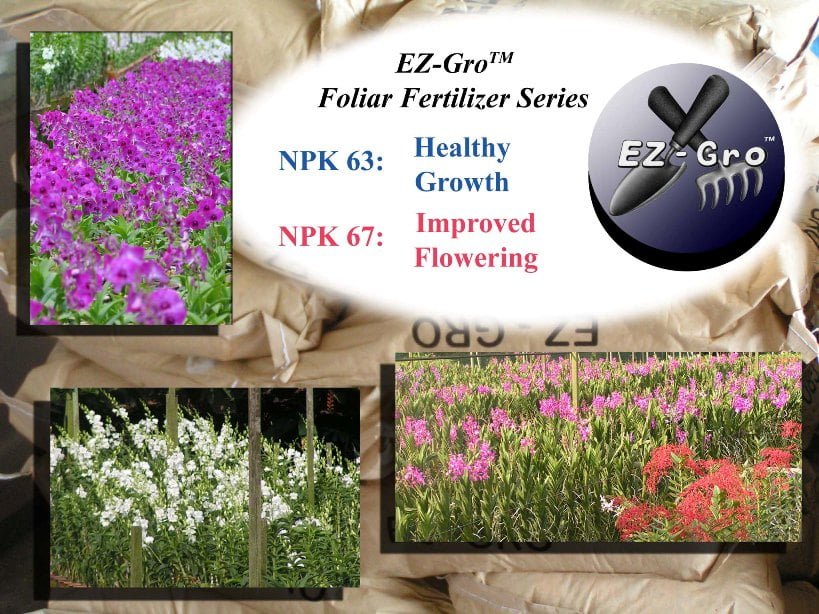
Dissolve half ~ one teaspoon (2.5 ~ 5 grams) of NPK fertilizer to 1 litre of water. Feed fertilizer solution to orchid plants’ roots. Bear in mind, not to water the plants on days of fertilizing, otherwise it will be doubling their fluid intake. Although NPK67 improves the quality and size of flowers, prolonged usage of NPK67 alone will result in stunted plant growth. The best way to go will be using NPK63 for 2~ 3 weeks; followed by 1 week usage of NPK67 or only switching to NPK67 prior / during the flowering season. Younger plants would require mainly NPK63 for vegetative growth. Otherwise, a pure diet of NPK63 would suffice in boosting the plant’s health and growth, laying good foundations for flowering. More often than not, NPK67 is treated as fertilizer that improves flowering frequency. This conception is true to some extent only, as the frequency of flowering depends on many factors such as the environment, general plant health and its inborn seasonal cycle. Bearing in mind, what NPK67 significantly improve is the quality (longer stalks / robust blooms) of the flower.
does one of those led growth light helps in promotion of growth and blossom?
Hi Yee Fong,
LED light are usually too weak for growing of tropical orchids but it might be possible for orchids that require lesser light.
silverelf
I have trouble with ants in my baskets, the orchids are hanging in my tree and some are full of ants
The ants generally don’t attack the orchid plants.. You might wish to try buying some ants pellet.. For non toxic repellent, you might want to try using some cinnamon.
silverelf
As I do not have time to drop by your gift shop and I have a question. Do you have fertilizer products (that comes in much smaller pack) for home /residential use? Appreciate your advice, thank you.
Hi Dennis,
Yes, we do have them in smaller packs for residential use.
silverelf
Um Silver elf, I’ve noticed some orchids cannot tolerate inorganic fertilisers while others thrive on them. So most orchids I find fall into either one or the the other camp, orgnic or inorganic. Can you tell me the best way to feed orchids that like organic fertilsers, I find getting the stuff to stick to roots a big problem. Where I live it rains a lot so i dont use substrate at all, if I did the roots would simply rot as i don’t have access to hard wood chips. So my orchids roots are free hanging or attached to trees. This is not a problem with inorganic lovers as you can simply spray with a spreader mixed into the solution. But how do you get fish emulsion or those sheep pellets to stick to the roots?
Regards (I hope to be buying some orchids from you in the next few weeks on my trip to Singapore)
I ask this question mainly out of curiosity:
If I mix 50% of 13.5 :27:27 with 50% of 21:21:21 ,
would the resulting formula be better still?
I emailed out of curiosity about mixing various fertilizer-formula together.
Would 13.5:27:27 and 21:21:21 solution be too strong for Orchids if 50% of
each was applied?
Hi Mr Teoh,
No the resulting formula will not be better, but more convenient. The NPK 63 (21:21:21) and NPK 67 (13.5:27:27) have different usage application. NPK 63 is for feeding purposes while NPK 67 is for flowering purposes. For best results, it is still better to apply them separately.
Mixing the 2 fertilizers @ application rate of 50% will not harm the orchids.
silverelf
Hi Anton,
You can simply apply the organic fertilizers the similar way you apply your inorganic fertilizers by mixing them with a spreader. I suppose your organic fertilizers are mostly emulsions? Just dilute them into the solution and spray them onto the orchids. You do not have to make sure that they stick to the roots, just like the inorganic fertilizers.
silverelf
Hi Silverelf,
You fertilize the orchids twice a week but I’d like to
know the intervals between application. Is it safe to fertilize once
every 3rd day eg. Monday, Wednesday, Friday, Sunday, Tuesday etc.at
full strength? I had to ask because my orchids are not flowering regularly.
Hi Mr Teo,
Yes, the idea is to space out the two intervals.
If its rains heavily and you are unable to fertilize, you can fertilize the next day as well.
The flowering frequency of the orchids are different for each type.
Some varieties flower more frequently than the others.
If you have a lot of sun and like orchids that flower frequently, I’ll recommend you the following orchids.
Vanda John Clubb, Mokara Moonlight, Mokara Singa Gold, Brassavola hybrids, Vandoritis Hao Xiang Ni.
These varieties flower more frequently in our climate under 80% to full sun.
silverelf
My orchids’response to increased dosage of your 13.5:27:27 was incredible!
Within a few days after application, flower spikes were produced mostly from
my Dendrobiums. I therefore would like to buy more packets of EZ-Gro 13.5:27;27
but where can I get them, apart from your Toh Garden? Do they have expiry dates?
I usually go to the nurseries in Hougang and only one has your formula BUT they
are in old-looking and dusty packets of 200g each and so they were never bought.
My main concern is their date of expiration.Your reply is important. Thanks!
Hi Mr Teoh,
There is no exact expiration date but I would advise to keep it for about 5 years. Most of the stock that we have is less than a year old.
A note on the application of NPK 13.5:27:27, do not overuse this NPK as it will cause the orchid stems to grow thinner and thinner as they exhaust their supply of stored sugars for flowering. After the flowering phase, feed them with NPK 21:21:21 so that they can grow fat before the next flowering.
Yes, some nurseries there do distribute our orchids and supplies. You may also order orchids directly from them if its more convenient for you to pick them up. =)
silverelf
Hi ! Recently I saw a fertilizer with NPK ratio of 15:45:15 . What is this
formulation beneficial to? And which NPK ratio is better to produce flowers-
15:45:15 OR 16:32:20 ?
Dear Silverelf,
I read that applying fertilizers to a flowering orchid
may cause premature wilting of the flowers. Some growers over the
internet gave unhelpful answers. They said that orchids don’t need
fertilizers during their flowering season because they do not help
the plant in anyway. So should I stop fertilizing to prevent early
loss? I need enlightenment on this topic. Thank You!
Dear Silverelf,
What is EZ-Gro’s 21:21:21 different from
other brands such as Polyfert’s 21:21:21 ? Do you
add macronutrients/trace minerals that Polyfert
doesn’t/does ?
Dear Silverelf,
What is the difference between 21: 21 : 21
from EZ-Gro and Polyfert?
Dear Zhang,
We haven’t use Polyfert 21:21:21 before and thus I can’t advise on this. But yes, there are trace elements added to our fertilizers. This is just in very small quantities of other ions such as calcium etc. The main composition of the fertilizers are still the nitrogen, phosphate and potassium composition.
silverelf
Hi,
Thanks for the article. When fertilizing, I use a spray for mounted orchids. Some have flowers, some have not. Is it ok if the flowers get sprayed as well with the Npk63 or npk67 ? Thanks
P.s. Do you have vanda mimi palmer at the moment ?
Hi Joe,
Thanks for reading. =)
It okay but not advisable to spray the flowers.
The flowers will not last if the pollen grains are dislodged.
We have the plant but its not in flower at the moment.
silverelf
Is it okay or better to mix 2 NPK formulae fertilizers
as a combination spray to give the orchids more nutrients?
In fact, I mix 13.3-27-27 with 15-45-15 and spray them every 4 days and they have started to produce flower spikes after a dry flowering spell of 2 months. Is this a coincidence or that the mixture is working. Is mixing of
different formulae risky in your opinion? Thank you.
Hi Zhang,
Its better to separate the 2 formula, and there’s no risk in mixing formula.
The only risk is over application of fertilizers.
When you mix your formula, you will still have to apply at the closely similar rate of dilution advised on the fertilizer packaging.
Over dosage of fertilizers is not good for the plant and excess fertilizers may promote fungal growth.
silverelf
Hello!
Can someone tell me what fertilizer can i give to a month-old vandas?
They were tissue cultured.
Thank you.
Is your fertilizer available in Malaysia?
Dear Lim,
Our fertilizers is currently not available in Malaysia aside from commercial shipment.
However, we can try to send them to you if you arrange a pickup via DHL or Fedex.
silverelf
I want to try out your fertilizers. Are they available in any nurseries other than toh garden?
Hi Choo,
Yes! You can get the fertilizers at Candy Floriculture, Retail Centres at Kovan, several market stalls all over Singapore (e.g. Tiong Bahru, Red Hill, Jurong, Bukit Batok etc).
You may also order our orchids with these stalls for convenience.
silverelf
Hi John,
Apply half the usual concentration for seedlings.
silverelf
Hi,
I bought 2 Airplants from Toh Garden at Bigbox. Can you recommend a suitable fertilizer for growth and flowering?
Thank You
Hi Patrick!
Thank you for your patronage!
You can use Ezi Gro NPK63 which is also available from the stall. Miss the plants once a week with it.
silverelf
I was told when the orchid is flowering, we should stop fertilising so as to avoid premature wilting? Is it true?
Hi Caroline,
That’s probably not true. We continue fertilizing our flowering orchids.
silverelf
Hi Silverelf,
Re: January 30, 2016 at 5:33 pm | Permalink
Hi Patrick! Thank you for your patronage! You can use Ezi Gro NPK63 which is also available from the stall. Miss the plants once a week with it. silverelf
I went to BigBox today (4 Feb 16) during lunch. I could not locate NPK63. I found 2 types of fertilizer; pink and blue near the airplants. Nothing on both to indicate that either is NPK63. Try asking the folks at the cashier counter, but to no avail.
Please advise.
Hi Silverelf
I understand from this thread that NPK64/67 is available at Bigbox. I’m residing in NE, pls confirm if can get there currently?
Hi, do you still have a stall in BigBox? Does Far East Flora sell your fertilizers?
Would NPK 67 help phalaenopsis to re broom?
Hi Jennifer,
NPK63 and NPK67 is no longer available at Big Box.
We were there for the flower show last year.
You can order it from our online shop or drop us an email to order.
We can provide delivery for small items like fertilizers and accessories at rate of $10 per trip.
silverelf
Hi Guan Hong,
No, we are only at BigBox for the orchid show.
You can order fertilizers from us online.
silverelf
Hi Anthony,
Yes, NPK67 is used for inducing flowering.
However, the orchid plant need to be mature in order for the flowers to be induced.
NPK63 is for growth and feeds the orchid during the resting phase for its recovery after flowering.
silverelf
Hello Silverelf,
Let’s say about dendrobium. If I grow them from seedling. How should I know dendrobium is mature and ready for flowering ?
Thanks.
Frenki
What is the urea content/percentage in the 2 types of fertilizers NPK 63 and 67?
Hi Tingting,
Its NPK63 12.6% Urea, NPK67 3.14% Urea.
silverelf
Hi Silverelf,
I recently obtained one long neglected strap leave Vanda, the leaves condition looks okay except few burned spots. But I have problem with its roots, I only have a few roots which absence of the greenish tip. How should I resume its health and trigger its root growths? Thanks
Hi Bryan,
Orchid roots without the green root tips have stopped growing. This can happen when the plants is transplanted or shocked.
If cultivated in the correct conditions, it will take about 3-6 months to recover.
You should be able to observe new root growth (with green tip) around the 3 months period if you are growing the orchid correctly.
silverelf
I’ve bought the EZ-Gro orchid fertilizers both blue and pink coloured packs (400gm) from your facilities in Singapore. I’ve different types of orchids in pot, namely mokara, Vanda, Oncidium, Cattleya, Dendrobium, Phalaenopsis and few other orchids which i can’t name. Plz advice me proper use of this EZ-Gro fertilizers.
I leave in Bangladesh and weather here is similar to Singapore weather.
Regards
Hello Chy,
As a basic guideline, apply the blue fertilizer twice a week, and the pink one twice a month. =)
silverelf
Hi,
What’s the ratio N:P:K for these 2? NPK63 and NPK67.
I ever bought the pink one when u had a boot in expo this year. Not sure if this is 63 or 67? 😐
Hi Dannie,
The ratio for the relevant type can be found on the packaging itself.
The pink foliar will be 67.
silverelf
Hi,
Can you deliver if I just want to buy fertilizers?
Hi Silverelf,
Gong Xi Fa Cai!
I’ve bought a pot of orchids at the market and not sure which type is it. Can you email me so that Ican you the photo. I’ll need your advise on whether direct sunlight is required as its indoor and with overhead led light…
Thank you,
Cathy
*Hi silverelf! Need your advise, im a newbie and been keeping orchids less then a year. My orchids vanda renanthera red dragon, estimate 2-3yrs old is in resting phase after flowering 3-4 months back and the top already grown 3-4 leaves. 1st question, Do i still fertilize with 21 21 21 ? or should i fertilize it now 13.5 27 27 on weekly basis? 2nd question, let say spike is showing, which npk should i use? 3rd question, went blooming with flowers which npk should i use, and if in hot weather can i water them let say on monday and fertilize it on the 3rd day alternatly? Sorry im a slow learner and lit confuse , hope you can guide me !🙏🌸
Hi Shockwave,
We fertilizer our orchids 21:21:21 twice a week and 13.5:27:27 twice a month.
Yes, you can water them more frequently on a hot day and its best to water them before fertilizing.
silverelf
Hi Siverleaf,
Where can I purchase the EZ Gro NPK 63 and 67 in Australia please.
Thank you, Jane
Hello Jane,
You can email us and we will send to you by parcel =)
silverelf
Hi, do you have orange flower Oncidium (dancing flower) and Equitant Oncidium?
hello Raymond,
Yes we have them.
silverelf
I live in a city where summer temperatures are between 36 to 40 C. Should orchids be exposed to such sun or is it better to keep them under a shade ? I have a few potted orchids.
Hi George,
It will be good if you have a greenhouse in this case to grow more varieties. Else during the hot summer you have to shade the orchids and likely water them more frequently. I suppose Papilionanda and Papilionanthe will do well though.
silverelf
Hi Silverelf,
I have a few questions regarding to fertilizer application for Dendrobium Phalaenopsis as follow:
1. Supply fertilizer on leave and root or root only?
2. Only apply fertilizer when orchid plant and orchid potting mix are dry?
I need you to teach the detailed fertilization process you are applying.
Best regard!
Nguyen Thu
From Vietnam
Hi Nguyen Thu,
You can read them here http://tohgarden.com/orchid-care/fertilizers/
If you are using foliar fertilizers, its possible to absorb
However, its more important to apply to the root media than to the leaves.
silverelf
I am a Sri Lankan.
how can order fertilizers from you online.Fri, 11:24
What is this blue and pink fertilizer?
NPK 67 If NPK 63 is applied, how can they be applied to Orchid?
Hi Inoka,
You can drop us an email for the order.
It’s possible for us to parcel to you overseas with postage fees.
silverelf
I m from KL
Like to buy fertiliser NPK 63 healthy growth
NPK 67 IMPROVED
PL ADVISE COST
Pl let me have cost of NPK 63 healthy growth
And NPK 67 improved flowering
How to pay
NPK 67 If NPK 63 says the price to get two each
PLS TEL ME Are there facilities HSBC CREDIT CARD?
How much manure should be applied to 500 plants
Hello Lee Poh,
They are $10+ and $12+ respectively.
If you are just getting fertilizers, you can buy them from our Lazada store to save on shipping.
silverelf
Hi Inoka,
If you are looking to purchase only one packet, you can order from our Lazada page.
The fertilizers will be delivered to you by parcel.
silverelf
Hello Lee Poh Cheong,
Kindly write in for the purchase so we can check for you.
It is possible to send our fertilizers to Malaysia by postal service.
silverelf
Hi Inoka,
Yes.
Credit card payment are via PayPal.
silverelf
Hi Inoka,
This is subjective.
It depends on how large your plants are.
Generally applying about 5 pellets per 8inch pot will be sufficient.
silverelf
What potash is in the fertilizers, NOP, MOP or SOP?
Hi RJ,
It depends on what fertilizers u are using.
You can usually find the content written on the packaging.
silverelf
Hi Silverelf, can you please advise how to use the NPK63 on orchid potted in charcoal? Thank you.
Hello CK
You can find it here
https://tohgarden.com/orchid-care/fertilizers/
silverelf
Do you run beginners courses on growing orchids?
Hello ST,
Not at the moment due to Covid restrictions.
We will have it again in future.
silverelf
I have a Phalaenopsis orchid repotted in charcoal. There are no longer any flowers and the spike has been cut to the base. I bought an NPK 21-21-21 fertiliser in a spray bottle. Currently I am spraying the underside of the leaves once every two-three weeks (following the instructions). I have two questions:
1. Can I spray on the exposed roots?
2. Can I use the spray to water the plant? If so, do I dilute the solution? If not, must I buy another fertiliser to fertilise the roots through watering?
Thank you.
Hello GC,
1. Yes, you can spray on expose roots and should do so.
2. You should follow the instruction on the bottle itself as the dilution differs.
silverelf